Your MVP Is Done. Now What? (A Guide to Escaping Validation Paralysis)
AI tools made building instant. But when you can rebuild your product in a weekend, validation discipline disappears. Here's why vibe coder founders are stuck, and what I'm building to fix it.
Kobi Levi
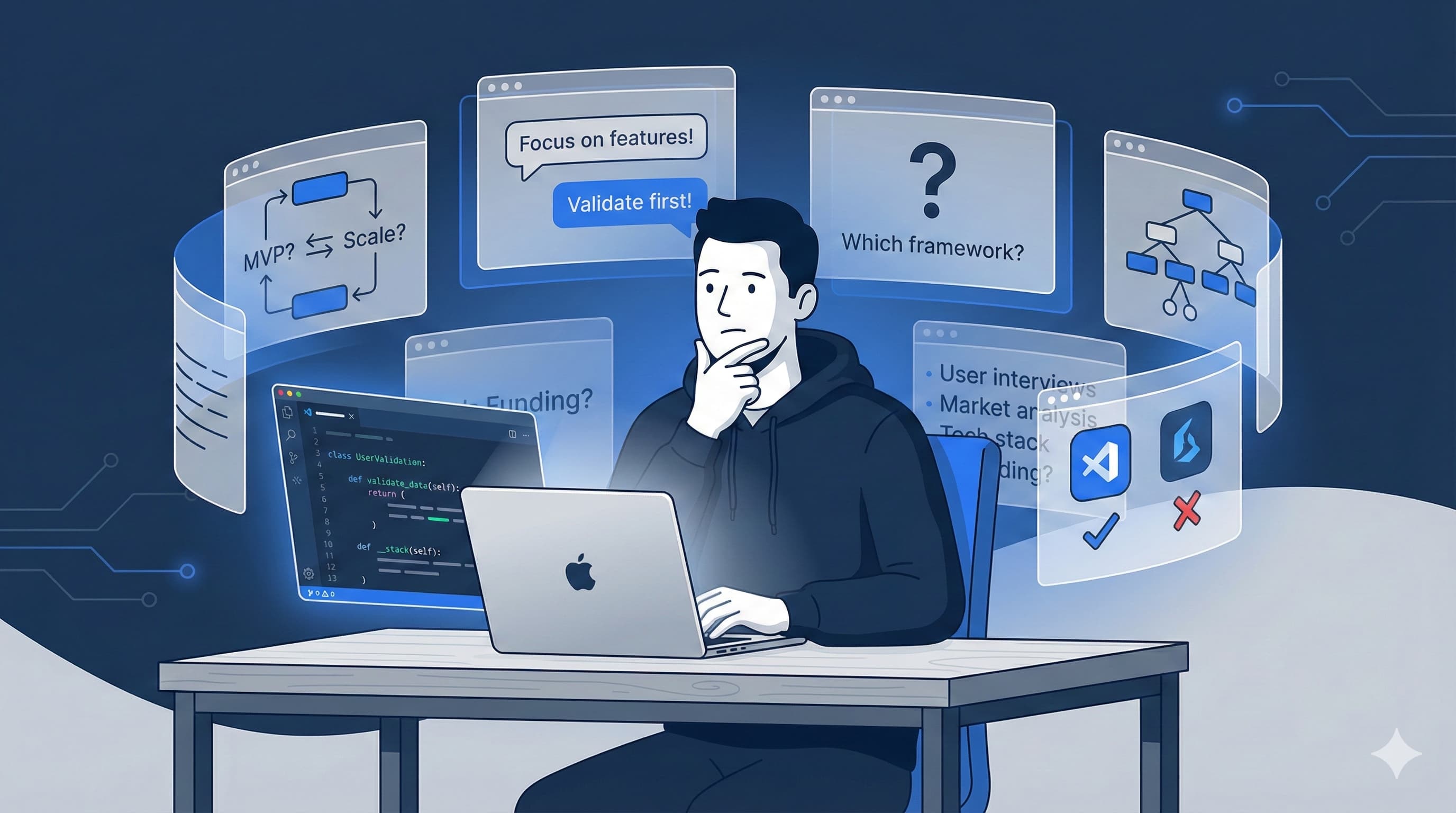
You spent three weeks building your MVP with Cursor. The code is clean, the UI is polished, and it actually works. You showed it to a few people who said "this is cool."
Now you're stuck. And if you're feeling that way, you're in good company.
You know you should validate, but every framework tells you something different. Talk to 50 customers. Build an MVP first. Start with a landing page. Run Facebook ads. Test your riskiest assumption. Which assumption? All of them?
This is validation paralysis. It's the most common place founders get stuck after building. And there's a clear way through it.
Why Building Got Easier But Validation Didn't
Here's something that took me a while to understand about tools like Cursor, Replit, and Lovable: they removed the friction from building, but not from validation.
When building took months and cost tens of thousands of dollars, founders were forced to validate first. The pain of building created natural validation discipline. But when you can ship a working product in a weekend, that forcing function disappears.
Building feels productive. Validation feels slow. So you build more.
You add features. You perfect the UX. You convince yourself that one more polish pass will make the difference.
Here's the thing: 42% of startups fail because they built something the market didn't need. Another 34% fail due to lack of product-market fit. These aren't technical failures. They're validation gaps.
But here's why this is actually good news: validation is a learnable skill. And once you understand what's happening, you can fix it.
The Real Reason Founders Skip Validation
Lean Startup methodology is more relevant today than ever. Build-measure-learn. Test your riskiest assumptions. Pivot when necessary. The framework is solid.
So why does almost nobody use it anymore?
When building was painful, validation wasn't optional. It was survival. Now you can rebuild your entire product over the weekend, so validation feels like something you'll get to eventually. You tell yourself: "I'll just build it first, see what happens, and iterate based on feedback."
This is where founders get stuck.
Or they do a half-hearted version. Run a landing page test, get 50 email signups, and call it validated. Then build for three months only to discover those signups were curiosity, not intent to buy.
That's a false positive. It's one of the most common validation mistakes, and it's completely avoidable once you know what to look for.
The alternative path isn't better. Consultants and courses will teach you to run 30 customer interviews, build a business model canvas, calculate your TAM, and write a 40-page validation report. By the time you finish, six months have passed and your competitor already launched.
You don't need either extreme. You need something in the middle: structured validation that keeps you moving.
The Question That Actually Matters
Here's what gets lost in all the frameworks: you don't need perfect validation. You need to know your next step.
Should you talk to five more potential customers or start building? Should you pivot your positioning or stick with it one more week? Should you test pricing now or wait until you have more users?
Stuck on your AI-built app, or chasing your first customers?
One team gets you unstuck, then gets you paying users.
These are dynamic decisions that depend on what you've already learned. A static framework can't answer them for you.
Some founders can recite Lean Startup principles perfectly. They've read The Mom Test. They know about minimum viable products and riskiest assumptions. But when I ask "what's your next validation step?" they freeze.
They have the theory but not the judgment. And that's not their fault. Judgment comes from doing the work, from having someone guide you through the first few cycles until it clicks.
What I'm Building to Help
This is why I'm building Pathforge.
Not another course on validation frameworks. Not a consultant you hire once and struggle to implement their advice. A co-pilot that knows your venture, your current step, and your assumptions, then guides you through the process like an experienced co-founder in your pocket.
Lean Startup works. The challenge is knowing which part to apply right now, in your specific situation. That's what Pathforge solves.
You tell Pathforge where you are: idea stage, built an MVP, have some users, whatever. It gives you one specific next action. Not 10 options. One action. Do this now. Here's why it matters. Here's what success looks like. Here's what comes after.
Built a landing page and got 100 signups? Pathforge tells you whether that's enough signal or if you need more data. Ran five customer interviews and heard mixed feedback? It helps you identify the pattern. Stuck between two different customer segments? It walks you through the decision.
The goal is simple: you always know your next step. Every action teaches you something. Every piece of data gets you closer to clarity.
Why Context Changes Everything
Static frameworks can't see that you're a solo founder with $5K in the bank and three months of runway. They can't tell that your last five interviews revealed the same objection, which means you've found a real pattern. They can't adapt when you discover your original problem isn't painful enough, but you noticed a different problem in every conversation.
Pathforge can.
It tracks what you've learned and identifies when you have enough signal to move forward. It flags when you're about to skip an important step, like building for six weeks without testing willingness to pay.
For founders using AI building tools, it solves the core tension: you can build anything, but you shouldn't build everything. Pathforge keeps you focused on learning rather than just building. It makes validation feel as productive as coding, because every step forward reveals something valuable.
Think of it as the validation discipline you'd have if building was still expensive. But adapted for a world where building is instant.
Join the Early Access
If you've used Cursor or Replit to build something in the last six months and you're not sure what to validate next, Pathforge is opening its doors to early users.
The goal is simple: you'll always know your next step. No more paralysis. No more building the wrong thing. Just steady progress toward product-market fit.
Join the early access waitlist here
AI made building too easy. Time to make validation just as frictionless.
Stuck on your build, or ready for your first customers?
One team takes your AI-built app from broken to working, then to paying users.
Get Unstuck
We rebuild your stalled app into a working MVP.
Get Your First Customers
Brand, funnel, and traffic until real users show up.
30+ startups reviewed · 20 years in tech · Now accepting 3-4 new clients