Your MVP Is an Experiment, Not a Product
Fast coding tools let you build MVPs in days. That's incredible, and dangerous. When building is easy, you add features instead of validating assumptions. Here's how to break that cycle.
Kobi Levi
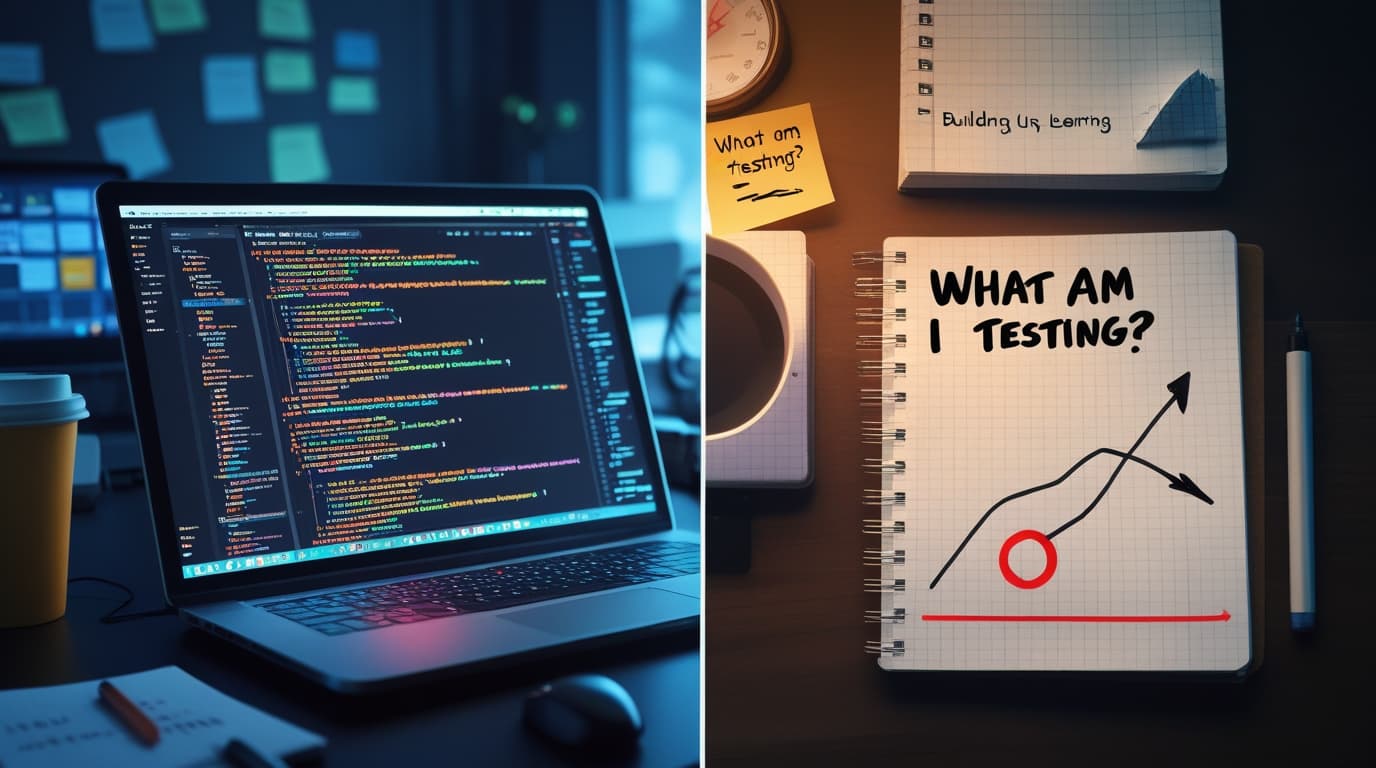
You just shipped your MVP using Base44. Took you three days. 50 signups in the first week.
Now you're adding features. A better dashboard. Social login. Email notifications. Because that's what MVPs need, right?
Wrong.
Your MVP isn't a product you're improving. It's an experiment you're running. And right now, you have no idea what you're testing.
The Question You're Not Asking
Before you add another feature, answer this: What assumption are you validating?
Not "is my product cool?" Not "do people like it?" Those aren't assumptions - they're hopes.
Real assumptions sound like:
"Small business owners will spend 10+ minutes setting this up"
"Users will invite their team within the first session"
"People prefer workflow A over workflow B"
"Someone will pay $29/month for this"
If you can't finish the sentence "I'm building this to test whether..." - stop building.
Why Fast Coding Makes This Worse
Tools like Base44, Lovable, and Cursor are incredible. You can build in days what used to take months.
But here's the trap: When building is easy, you build instead of think.
You add features because you can, not because you should. The friction that used to force you to prioritize is gone. So you ship everything, measure nothing, and learn nothing.
Speed is only valuable if you're moving in the right direction.
What You Should Build Into Every MVP
Not more features. Measurement.
Your MVP needs to answer specific questions:
Do users activate? (Complete your core action, not just sign up)
Do they come back? (Day 1, Day 7 return rates)
Do they hit the "aha moment"? (Experience the value you promised)
Where do they quit? (Which step in your flow breaks)
These aren't vanity metrics. They're answers. And you can't get them by counting signups.
The Two Tests That Matter Most
Smoke Test: Before You Build
Put a button in your app for a feature you're considering. When users click it: "We're building this. Leave your email to get notified."
If nobody clicks after two weeks - the feature is dead. If 40% of users click - build it immediately.
This works for entire products too. A landing page with a signup form is a smoke test. You learn if people care before you write code.
Stuck on your AI-built app, or chasing your first customers?
One team gets you unstuck, then gets you paying users.
A/B Test: When You Have Two Ideas
You think users want detailed analytics. Maybe they just want a simple yes/no answer.
Don't debate it. Test it.
Version A: Complex dashboard
Version B: Simple status indicator
Measure which one gets more people to return and use your product. Data ends the argument.
Build to Invalidate, Not to Confirm
Here's where founders go wrong: They measure things that make them feel good.
"Look, 10 people used my new feature!"
Okay. Did it change their behavior? Did they come back? Did it solve the problem you think exists?
Your job isn't to prove your idea works. Your job is to try to prove it doesn't work. If it survives that scrutiny - you might have something.
This means:
Set falsifiable targets: "If under 20% complete onboarding, this approach is wrong"
Measure failure, not just success: Track bounces, exits, abandoned flows
Kill features that don't move your core metrics: Elegant code doesn't matter if users ignore it
Start Here: This Week
Write down your riskiest assumption: The one thing that, if wrong, kills your business
Define what "validated" looks like: A specific number that proves or disproves it
Add tracking to your core user flow: Every step from signup to value
Set a decision date: One week from now, look at data and decide: pivot, persevere, or kill
Don't have a core flow yet? That's your real problem.
Figure out the ONE thing users must do to get value. Build that. Measure that. Ignore everything else.
The Hard Part
Base44 made building fast. But it can't tell you what to build.
Only your users can tell you that. And they won't tell you with words - they'll tell you with behavior.
Your job is to measure that behavior, believe what it's telling you, and act on it.
Most founders won't. They'll keep adding features, hoping something sticks.
Don't be most founders.
Not sure what assumptions to test or how to structure your validation experiments? I help early-stage founders design MVPs that answer the questions that matter. Book a consultation and let's make sure you're building the right thing, not just building fast.
Stuck on your build, or ready for your first customers?
One team takes your AI-built app from broken to working, then to paying users.
Get Unstuck
We rebuild your stalled app into a working MVP.
Get Your First Customers
Brand, funnel, and traffic until real users show up.
30+ startups reviewed · 20 years in tech · Now accepting 3-4 new clients