Why $30K Won't Save Your Startup (But $3K Might)
Ready to quit your job and invest $30-50K building your app? Before you do, there's a $3K step that 42% of failed founders wish they hadn't skipped. Here's how to validate before you build.
Kobi Levi
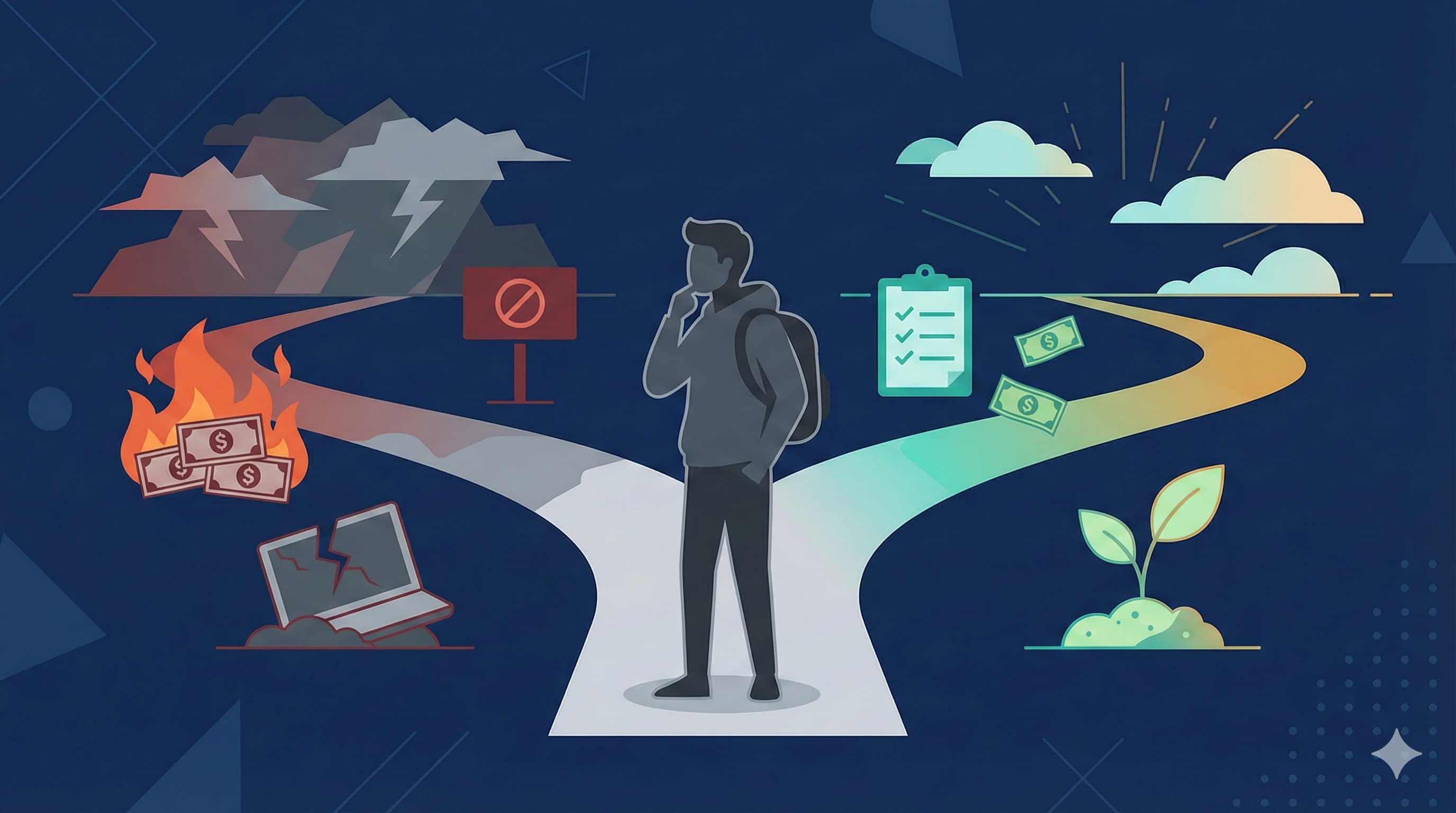
I see it every day in founder communities. Someone posts: "I'm ready to quit my job and invest $30-50K building my app. Looking for developer recommendations."
And my stomach drops.
Not because building is wrong. Building is exciting. Building feels like progress. But for 42% of startups, what they're about to build is something nobody will pay for.
That's the #1 reason startups die. Not bad code. Not weak marketing. Not underfunding. No market need.
Here's the uncomfortable math: you're about to spend $30,000+ and 6+ months building a product when you could spend $2-3K and 4-6 weeks proving whether anyone actually wants it.
The $1.75 Billion Lesson
In 2020, Quibi launched with $1.75 billion in funding. They had Jeffrey Katzenberg (former Disney chairman) and Meg Whitman (former HP CEO) at the helm. A-list celebrities. Super Bowl ads. Proprietary tech that let you switch between portrait and landscape viewing.
Six months later, they sold the company for $100 million.
What went wrong?
According to Babson professor Yasuhiro Yamakawa: "The number one reason startups fail is they have a solution without a problem."
Quibi never validated that people actually wanted short-form premium content on their phones. They assumed. They built. They burned through $1.4 billion before realizing the assumption was wrong.
You probably don't have $1.75 billion to burn. Neither do I.
That's why validation isn't optional. It's survival.
What Validation Actually Costs
Proper validation includes customer discovery interviews, landing page tests, fake-door experiments, and willingness-to-pay conversations. All in, you're looking at around $2-3K and 4-6 weeks of focused effort.
Compare that to MVP development:
Direct cost: $15,000-150,000
Timeline: 3-6 months
And here's what most founders don't factor in: building an MVP often means quitting your day job. That's not just the development cost. That's your salary gone. Your safety net gone. Your runway shrinking every month while you build something that might not work.
Suddenly you're not comparing $3K to $50K. You're comparing $3K to $50K plus 6 months of lost income plus the pressure of an empty bank account forcing you to ship before you're ready.
The math isn't close.
The Two Outcomes (Both Are Wins)
After validation, you'll find yourself in one of two places:
Outcome 1: You discover real demand.
Your interviews reveal a pattern. Multiple people describe the same pain. Some are already spending money on inferior solutions. When you show them your concept, they ask "When can I buy this?"
Now you build. But you build with confidence. You know what features matter. You know what to skip. You know who will pay and how much.
This is how Instagram happened. The founders built an app called Burbn with a dozen features. Users ignored everything except the photo-sharing piece. They stripped everything else out, pivoted, and sold to Facebook for $1 billion.
Slack came from a failed video game called Glitch. The internal chat tool the team built to communicate was more valuable than the game itself.
Validation showed them where the real opportunity was.
Outcome 2: You discover the idea won't work.
Your interviews reveal problems: The pain isn't severe enough. The target market is too small. People say they like the idea but won't commit to paying.
This feels like failure. It's actually the opposite.
You just saved $30,000+ and 6+ months of your life. You can pivot to a better idea, target a different market, or tweak your solution based on what you learned.
According to the Startup Genome Report, startups that pivot 1-2 times raise 2.5x more money and have 3.6x better user growth than those that don't pivot at all.
Learning your idea won't work before you build it isn't failure. It's wisdom.
Why Founders Skip Validation (And Why You Shouldn't)
I know why validation feels unnecessary. I've been there.
Stuck on your AI-built app, or chasing your first customers?
One team gets you unstuck, then gets you paying users.
"I already know the market." Maybe. But 42% of failed founders thought they did too.
"Building is faster now with AI tools." True. You can ship an MVP in weeks with Cursor or Claude. But easy building doesn't mean easy selling. If anything, it makes validation more important. When building is cheap, the differentiator becomes knowing what to build.
"I just need to get something in front of users." This is the trap. Shipping something nobody asked for doesn't generate useful feedback. It generates confusion and crickets.
"Validation takes too long." It takes 4-6 weeks. Development takes 3-6 months. You do the math.
"I don't know how to validate." This is the only valid reason. Most founders never learned customer discovery, interview techniques, or how to design validation experiments. It's not taught in coding bootcamps or YouTube tutorials. But it's a solvable problem.
What Validation Actually Looks Like
With 10 years of product management experience and having validated 20+ startups as an analyst and PM, I've seen what separates ideas that gain traction from those that don't. Here's what proper validation includes:
Problem Discovery Interviewing 20-30 potential customers to understand if the problem you're solving is real, painful, and worth paying to fix. Most founders skip this or do it wrong by pitching instead of listening.
Solution Validation Testing whether your proposed solution resonates. This doesn't require code. Landing pages, prototypes, and concept demos can tell you everything you need to know.
Willingness to Pay The most skipped step. Getting verbal interest is easy. Getting someone to click "Buy Now" or put down a deposit is the real test. Fake-door experiments and pre-sales reveal the truth.
Market Sizing Making sure that even if you win, the prize is worth winning. A validated idea in a tiny market is still a business problem.
When these four elements align, you have something worth building. When they don't, you have something worth changing.
Keep Your Day Job (For Now)
Here's my honest advice: don't quit your job to build an unvalidated idea.
Instead:
Keep the income while you validate (4-6 weeks of evenings and weekends)
Spend $2-3K maximum on validation experiments
Talk to 20-30 potential customers
Get 10+ people to demonstrate real purchase intent (clicking "buy," joining a paid waitlist, verbally committing)
If validation succeeds? Then consider the leap.
If validation fails? You still have your income, your savings, and a much better understanding of what problem to solve next.
The founders who make it aren't the ones who build fastest. They're the ones who learn fastest.
Don't Know Where to Start?
Validation sounds simple in theory. In practice, most founders struggle with:
What questions to ask in customer interviews
How to find the right people to talk to
How to design experiments that give clear answers
How to interpret the results without bias
When to pivot vs. when to push forward
After 10 years as a product manager and validating 20+ startups, I've seen what works, what doesn't, and where founders consistently get stuck.
If you're sitting on a startup idea and want to validate it properly before investing serious money and time, I can help.
Book a free 30-minute validation strategy call
We'll look at your idea, identify the riskiest assumptions, and map out a validation plan that costs a fraction of what you'd spend on development.
Because the best time to find out if your idea works isn't after you've quit your job and spent your savings. It's now.
Stuck on your build, or ready for your first customers?
One team takes your AI-built app from broken to working, then to paying users.
Get Unstuck
We rebuild your stalled app into a working MVP.
Get Your First Customers
Brand, funnel, and traffic until real users show up.
30+ startups reviewed · 20 years in tech · Now accepting 3-4 new clients