The Project-to-Product Shift That Turns Builders Into Founders With Paying Customers
The fastest way to make the transition from project to product is not adding another feature. It is locking your entire scope around one specific pain your
Kobi Levi
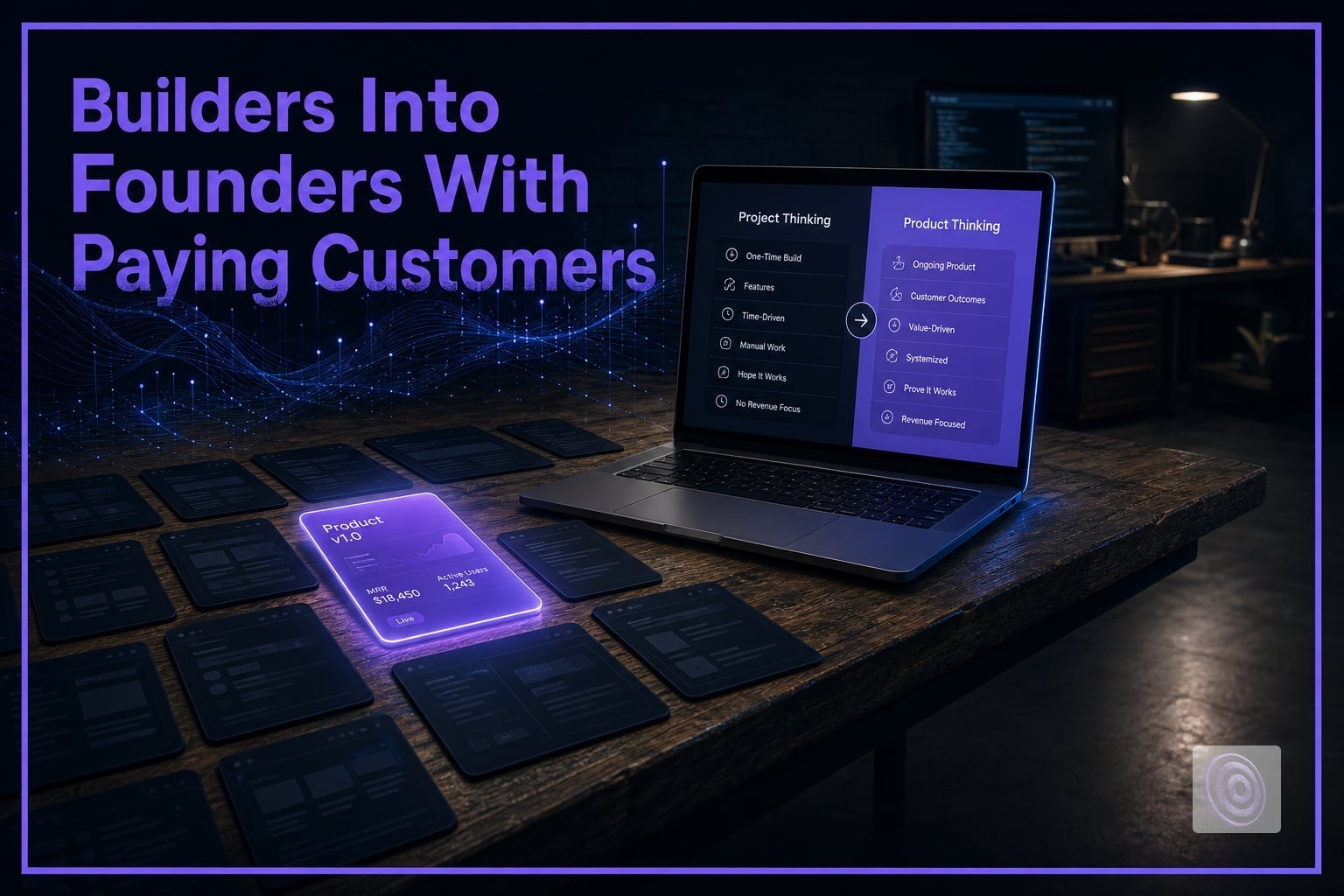
The Project-to-Product Shift That Turns Builders Into Founders With Paying Customers
The fastest way to make the transition from project to product is not adding another feature. It is locking your entire scope around one specific pain your user will pay to eliminate. Everything before that decision is expensive guessing.
Key Takeaways- One pain point beats ten features: scope locked around a single user problem converts faster than a broad feature set.
- The readiness signal is behavioral: a user who says they would miss your product unprompted is your green light to charge.
- Startup NPD failure rates hit 90% when founders build without validating one specific pain first.
- Stop iterating when the signal arrives. More building after that point delays revenue.
Why Your App Feels Finished but Still Has No Users
An app becomes a product the moment it solves one specific pain for a defined user. Until then, it is a collection of features waiting for a purpose.
You built something real. It runs. You can demo it. But "it works on my machine" and "people pay for it" are two completely different milestones, and most builders confuse finishing the first one for reaching the second.
Here is the contrast that matters. A project has a completion state. A product has a user state. Projects end when the code ships. Products begin when a real person's problem disappears.
The gap is not technical. Your code is probably fine. The gap is that your scope was never locked around one painful, specific problem a real person faces every day. According to StudioRed's product development research, startup NPD failure rates can reach 90%, driven by limited resources and building without validated demand. That number is not about bad code. It is about building the wrong thing for the wrong reason.
This is the diagnosis every competing article skips. They describe the mindset shift in abstract terms. They do not tell you what to do on Tuesday morning. That changes now.
Lock Your Scope Around One Pain Before You Touch Another Feature
Founders who ship a focused solution to one painful, specific problem convert users to paying customers faster than founders who keep adding features to impress everyone.
Most articles tell you to "validate your idea." That is not specific enough. Here is the three-question scope-lock test you run before writing a single line of new code:
- Can you name the pain in one sentence, in your user's words? Not "productivity" or "workflow." Something like: "I spend two hours every Monday manually moving data between two tools."
- Does your app already eliminate that pain completely? Not partially. Completely. If no, that is your only job.
- Would a user pay to keep that pain gone? If you have to guess, you have not asked. Go ask three real people this week.
Stuck on your AI-built app, or chasing your first customers?
One team gets you unstuck, then gets you paying users.
If you answer yes to all three, your scope is locked. Stop building. Start selling.
If you answer no to any of them, every new feature you add is scope creep dressed up as progress. As Project Management Tips on Medium notes, uncontrolled scope expansion leads directly to budget overruns and missed timelines. For a solo founder spending their own money, that is not a project risk. It is a business-ending one.
LeanSpot's approach with AI-built startups is built around this exact moment. Rather than asking founders to spec a finished product, the process specs the minimum scope together, targeting the one pain worth solving first. That is how a stuck project becomes something a user will pay for.
The Signal That Tells You It Is Time to Charge
Your product is ready when a real user, unprompted, says they would miss it if it disappeared. Everything before that signal is still validation, not readiness.
Picture this: you send a casual check-in to someone using your app. You ask how it is going. They write back: "Please don't take this away, I use it every single day." That sentence is worth more than any analytics dashboard.
Three indicators tell you the signal is real, not polite:
- Unprompted return visits: they come back without a reminder from you.
- Specific language about the pain: they describe what life was like before your app, not just that they like it.
- Resistance to stopping: when you ask if they would stop using it, they push back.
According to Nielsen Norman Group, identifying pain points is the first step to building solutions that address real user needs. The inverse is also true: if users cannot articulate the pain your product removes, you have not locked scope tightly enough yet.
This is where most builders stall. They keep iterating past the signal because building feels safer than selling. Do not do that. When the signal arrives, your next move is pricing, not features.
If you are not sure whether you have hit that signal yet, LeanSpot offers a direct diagnosis: a strategy call that identifies your real blocker and tells you honestly which stage you are at.
Your Next Move Is Specific and It Is Today
You have a working app. You have a real user somewhere who needs what it does. The only thing between you and a paying customer is a locked scope and the courage to stop building and start asking.
See exactly where your product is stuck: a strategy call identifies your real blocker and gives you a locked scope you can build from today.
Stuck on your build, or ready for your first customers?
One team takes your AI-built app from broken to working, then to paying users.
Get Unstuck
We rebuild your stalled app into a working MVP.
Get Your First Customers
Brand, funnel, and traffic until real users show up.
30+ startups reviewed · 20 years in tech · Now accepting 3-4 new clients