The Founder's Guide to Minimizing Risk in App Development Partnerships
Effective risk reduction in app development comes down to three pre-contract decisions: locking in scoped deliverables, securing full asset ownership, and
Kobi Levi
The Founder's Guide to Minimizing Risk in App Development Partnerships
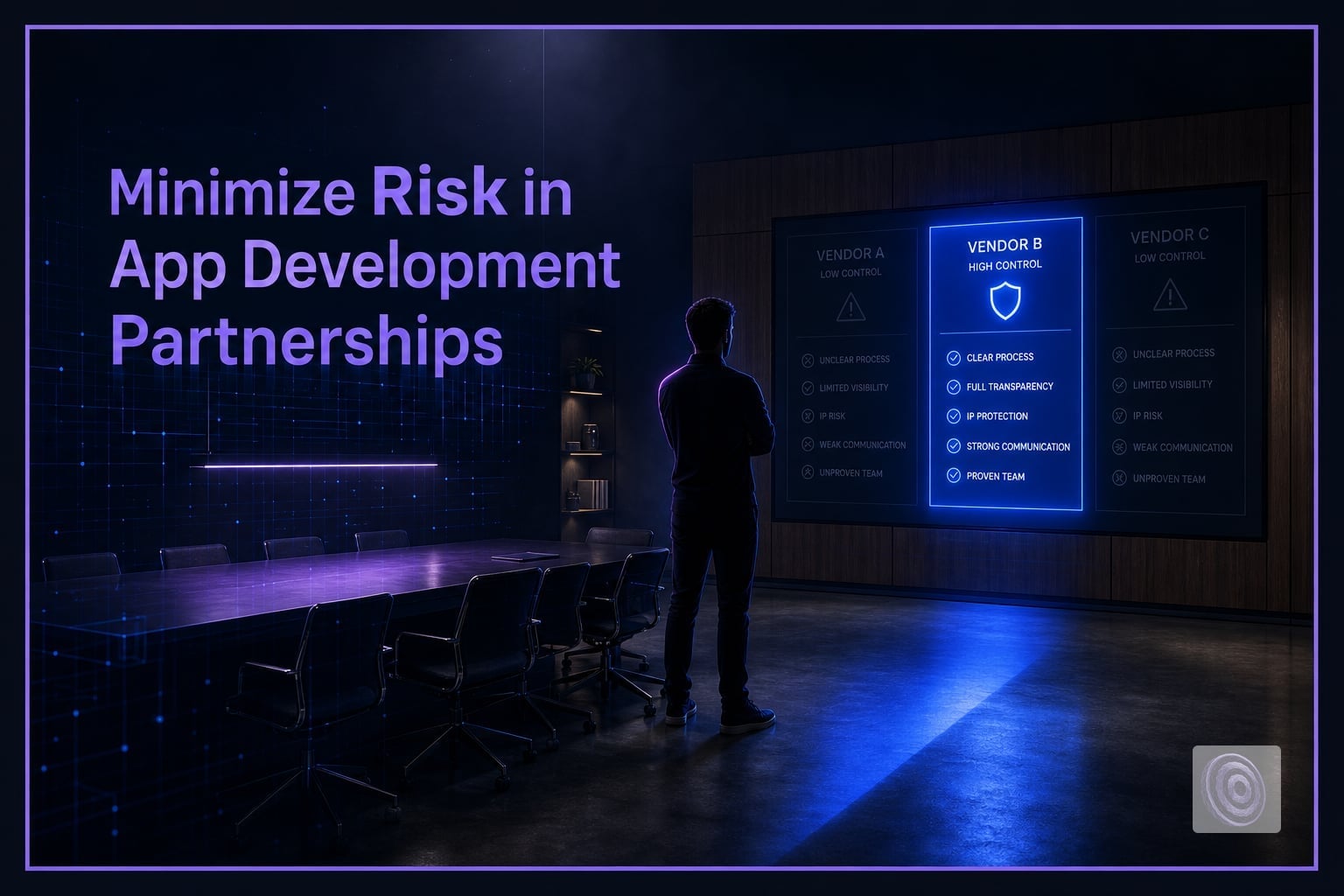
Effective risk reduction in app development comes down to three pre-contract decisions: locking in scoped deliverables, securing full asset ownership, and getting an honest read on where your project actually stands. Miss any one of them and you are not managing risk. You are funding it.
Key Takeaways
- 66% of app projects run over budget and 33% miss deadlines, per Leanware. The cause is almost always pre-contract, not technical.
- Full ownership in writing means code, designs, accounts, and docs. All of it. Before you sign.
- Milestone-scoped deliverables give you exit points. Vague final outputs give the vendor leverage.
- Stage assessment first. Building on a broken foundation costs more than starting over.
Why Most App Partnerships Fail Before a Line of Code Is Written
Most app partnerships fail not from technical errors but from missing agreements on scope, ownership, and project readiness before work begins. The contract is signed, the kickoff call happens, and the problems that sink the project were already baked in.
The numbers are stark. Leanware reports that 66% of app projects run over budget and 33% miss deadlines. The root cause is rarely bad code. It is a bad agreement, or no real agreement at all.
Most competing guides treat this as a technical problem. They recommend better QA, more sprints, stronger architecture reviews. Those matter later. But NimbleWork is direct: undefined scope and unclear ownership are the leading drivers of project failure. The failure is structural, and it is set before development starts.
You are probably focused on finding a vendor with the right tech stack. That focus is costing you. The three safeguards that actually protect your build, scoped deliverables, full asset ownership, and an honest stage assessment, are pre-contract decisions. The next two sections show you exactly what to demand.
Milestone-by-milestone deliverables, not a vague final output.
Red flag: no written milestones before kickoff.All code, designs, accounts, and docs belong to you on day one.
Red flag: vendor retains repo or account access after project ends.Honest diagnosis of where your project stands before any build begins.
Red flag: vendor jumps to proposals without reviewing your current state.The Ownership and Deliverables Checklist Every Founder Needs
Stuck on your AI-built app, or chasing your first customers?
One team gets you unstuck, then gets you paying users.
Before signing, confirm in writing that you own all code, designs, accounts, and documentation, and that deliverables are scoped milestone by milestone, not as a vague final output. This is not a negotiation. It is the baseline.
Most vendor contracts hand you a finished product at the end. That sounds fine until the relationship sours, the vendor goes dark, or you need to switch teams. TechTarget defines vendor lock-in as the state where switching providers becomes prohibitively costly. Without explicit ownership clauses, you are building toward that trap from day one.
Projects with clear objectives are 50% more likely to succeed, per Leanware. Clear objectives start with clear deliverables. LeanSpot's approach skips the "send us your spec" handoff entirely. Instead, the team works with you to scope a minimal product that actually fits your stage, so deliverables reflect what you need, not what sounds impressive in a proposal.
- Source code repository transferred to your account on day one
- All design files (Figma, assets) owned and accessible by you
- All third-party accounts (hosting, DNS, APIs) registered in your name
- Full documentation: architecture, API specs, deployment instructions
- Milestone-by-milestone deliverables with acceptance criteria in writing
- Clear exit clause: you can leave after any milestone without penalty
- No proprietary tooling that only the vendor can access or maintain
How Honest Stage Assessment Shields Your Build from the Start
An honest evaluation of where your project actually stands prevents you from paying to build on a broken foundation. Most vendors skip this step because it can slow the sale. That silence is expensive for you.
Picture this: you have a vibe-coded prototype built in Lovable or Bolt. It works locally. A vendor reviews your brief, proposes a full build, and you sign. Six weeks later, they discover the architecture cannot support real users. You pay to rebuild what you thought you already had.
NimbleWork notes that risk identification is most valuable at the earliest project stage, before commitments are locked in. A stage assessment at the start surfaces those structural issues before they become line items.
Having reviewed 30+ startup builds across tools including Lovable, Bolt, Base44, Cursor, and Replit, LeanSpot's team has seen the same walls appear repeatedly. The honest diagnosis, delivered before any proposal, is what separates a productive partnership from a costly restart.
See exactly where your project stands.
Get an honest, no-commitment diagnosis from a team that has reviewed 30+ startup builds. We will tell you the truth about your stage, what is working, what is not, and what to do next.
Stuck on your build, or ready for your first customers?
One team takes your AI-built app from broken to working, then to paying users.
Get Unstuck
We rebuild your stalled app into a working MVP.
Get Your First Customers
Brand, funnel, and traffic until real users show up.
30+ startups reviewed · 20 years in tech · Now accepting 3-4 new clients