The Clean Architecture Blueprint That Breaks Your AI App's Bug Loop
Applying clean architecture to AI apps is the single move that ends the bug loop for good. Every fix you prompt creates a new break because your UI, logic,
Kobi Levi
The Clean Architecture Blueprint That Breaks Your AI App's Bug Loop
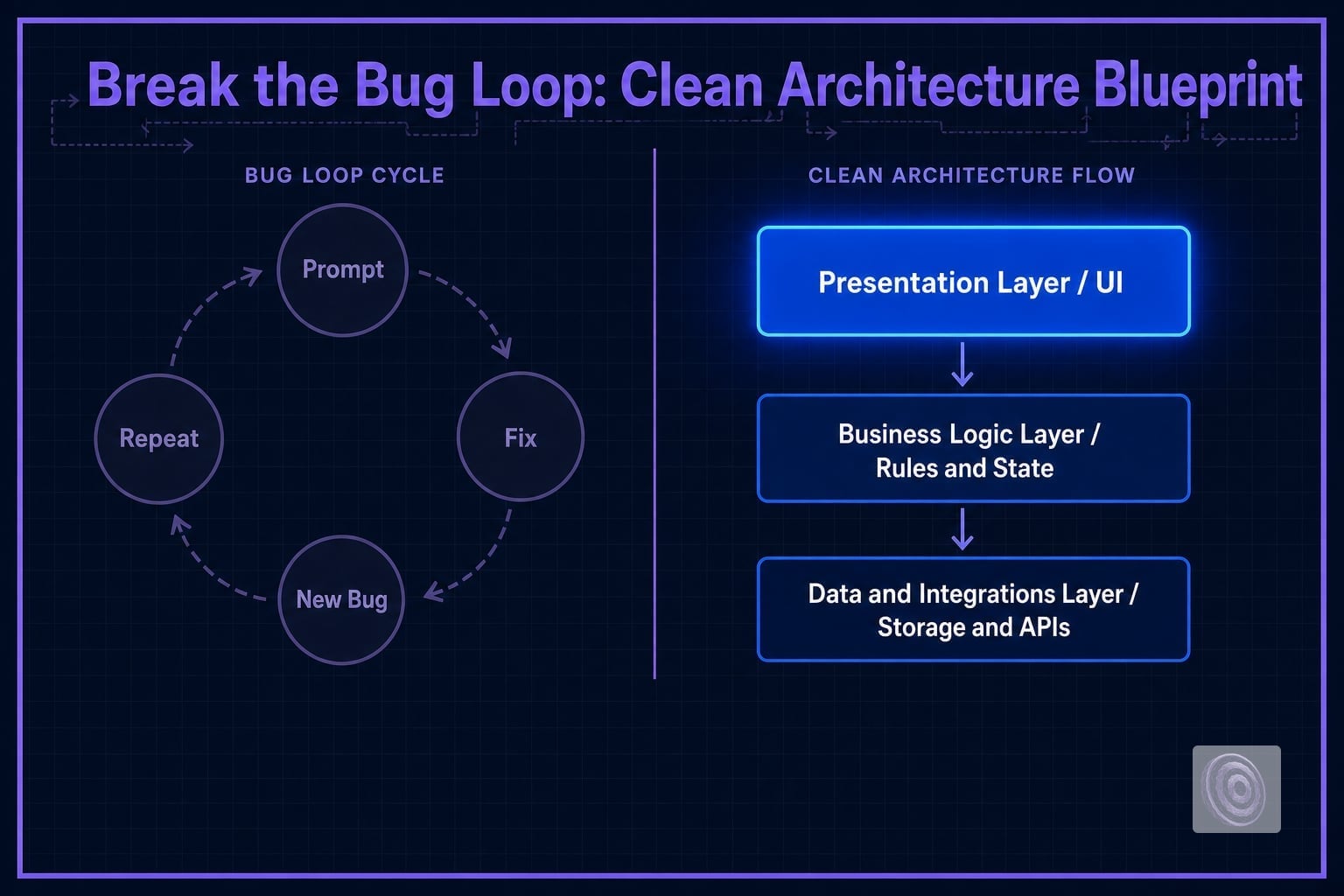
Applying clean architecture to AI apps is the single move that ends the bug loop for good. Every fix you prompt creates a new break because your UI, logic, and data are tangled together. Separate those three layers and the cascade stops. This blueprint shows you exactly how, based on patterns observed across 30+ AI-built startups.
Architecture beats prompting: Recurring bugs trace to missing layer separation, not bad code. Fix the structure and the symptoms disappear.
Three layers, one rule: Presentation, Business Logic, and Data must never touch directly. One crossing point creates a cascade.
Validate before you build: A 30-minute paper audit catches architectural violations before they compound into weeks of debugging.
Speed follows structure: TestingXperts reports teams with scalable AI pipelines deploy 3–5x faster than those stuck in siloed systems.
Why Your AI App Keeps Breaking (It Is Not the Code)
Persistent, recurring bugs in AI-built apps almost always trace back to missing separation of concerns in the architecture, not to individual lines of bad code. Here is the contrast that matters: a prompt fix treats the symptom. A structural fix removes the cause.
You are probably doing this right now: fix a broken form submission, and suddenly the authentication flow breaks. Fix authentication, and the API calls start failing. The code itself is fine. The problem is that every layer is touching every other layer, so a change anywhere ripples everywhere.
According to TestingXperts, 71% of enterprises cite architectural limitations as the top barrier to scaling AI. Solo builders hit this wall earlier and harder, because AI tools like Lovable and Bolt generate working code fast but make no guarantees about structure.
The 2025 DORA Report via InfoQ puts it plainly: AI acts as a multiplier of existing engineering conditions. Strong structure gets stronger. Fragmented structure gets more fragmented, faster.
Stop prompting for fixes. Start asking where your layers are crossing. That is the only question that breaks the loop.
The Three Layers That Give Your AI App MVP a Stable Foundation
A clean AI app MVP needs exactly three layers: a Presentation layer (UI and prompts), a Business Logic layer (rules and state), and a Data and Integrations layer (storage and APIs), kept strictly separate.
Picture this: you built a task manager with Cursor. Your "complete task" button calls the database directly from the UI component. It works. Then you add a notification feature, and everything breaks because the completion logic is buried inside a button click, invisible to the rest of the app.
Here is the three-layer fix:
Presentation layer: Handles what the user sees and interacts with. No business rules live here. It calls the logic layer and displays results.
Stuck on your AI-built app, or chasing your first customers?
One team gets you unstuck, then gets you paying users.
Business Logic layer: Owns all rules, state, and decisions. "Can this user complete this task?" lives here, not in the UI.
Data and Integrations layer: Manages storage, external APIs, and AI model calls. Nothing above it knows how data is stored.
The Azure Architecture Center reinforces this: unified, modular stacks are the foundation for any AI system that needs to scale without spiraling costs. LeanSpot's review of 30+ AI-built startups confirms the same pattern at MVP scale: every stable app had clear layer boundaries; every bug-looping app did not.
The rule is simple: no layer skips its neighbor. Presentation calls Logic. Logic calls Data. Never the other way around, and never across layers.
How to Validate Your Architecture Before You Write Another Line of Code
Before writing more code, map your app's three layers on paper, identify any place where UI logic touches data directly, and treat every crossing as a bug waiting to happen.
Ask yourself this: can you change your database without touching a single UI file? If the answer is no, you have a crossing. That crossing is where your next bug will be born.
Instead of running this audit yourself, hand it off to your favorite LLM coding agent. Give it the following instructions and let it do the heavy lifting, including fixing the violations it finds:
Scan every file in this project and classify it as Presentation (P), Business Logic (L), or Data (D) based on what it actually does.
Identify every function call or import that crosses layer boundaries, specifically any place where a P file touches a D file directly, or where calls go in reverse order.
For each violation found, refactor the code to route it through the correct intermediate layer, maintaining the same behavior.
Output a summary of every crossing you found and every fix you applied, so I can review the changes.
Another recommendation: build this audit as a reusable skill or custom agent instruction set, and run it periodically on your codebase, especially after major feature additions or AI-assisted sprints. Catching layer drift early is far cheaper than untangling it later.
Softlandia identifies entangled model and application logic as the most common AI architecture pitfall, and the fix is always the same: draw the boundary first, then enforce it in code.
LeanSpot works through this audit with founders directly, speccing the minimal product structure together before a single new line is written. That process consistently uncovers the one or two crossings responsible for 80% of the bugs.
Tenet's 2026 AI development research shows 66% of developers receive AI solutions that are almost correct but still fail. Almost correct on a broken foundation is still broken. Validate the structure first.
See exactly how a clean architecture diagnosis works: explore a real AI-built app teardown and walk away knowing what to fix first. Understand how structural loop drift compounds in unstructured apps, then apply the three-layer audit to your own project today.
Stuck on your build, or ready for your first customers?
One team takes your AI-built app from broken to working, then to paying users.
Get Unstuck
We rebuild your stalled app into a working MVP.
Get Your First Customers
Brand, funnel, and traffic until real users show up.
30+ startups reviewed · 20 years in tech · Now accepting 3-4 new clients